Delphine took me back to Bujora to complete our tour. We saw the rest of the buildings and heard some interesting stories about the Kings and traditional healers. We then went further down the road to a Cultural Tourism Centre in the next village where we met with the Pastor who runs it. Since his plans were similar to what we had already explored with other centres, we suggested he look for activities that would involve the tourists participating more in cultural activities - such as wood carving. My remaining time is already spoken for but Delphine promised to return to see what he had to offer. He was grateful for any consideration and we stood in prayer so he could give thanks to God for our visit. (You cannot escape religion in this country.)
Below is a traditional Sukuma house, as seen at the Bujora Centre. Female children would sleep on one side in the corridor and males on the other. The parents would sleep in the room in the middle - and close their 'door' by layering sticks on top of each other. Interesting fact: at night a goat was tied to each entry way of the corridors to act as their alarm system. If hyenas or other wild animals came to attack, they would get the goat first - before the children. The father would hopefully wake up at the sound of a goat being killed and come out to save his children.
Above is Father Clement's gravesite. He was the French-Canadian who created this centre and brought Christianity to the area. Although Father Clement died and is actually buried in Canada - the people of Bujora wanted to honour him with this memorial to him. He was like a modern-day Jesuit priest, connecting traditional indigenous beliefs with the church.
On the way back to Igoma, I convinced Delphine to stop at nane-nane - the annual 'agricultural' fair held for 8 days. Unfortunately, today was the last day so the crowds were INSANE!!! It was much easier to see everything when I went with Timothy on Friday. Today left us both feeling very claustrophobic. We were trying to make our way through the crowds when I heard 'Carrie, Carrie' - which is how many people here pronounce my name. I turned and saw Harisi - one of the sponsored students I met yesterday at Agape Lodge. He is in Standard 7 and wants to be a doctor. We chatted for a bit. I guess he was able to spot me easily amongst the thousands of people, since I was the only mzungu around.
Because the traffic was so crazy, I had Delphine drop me off on the main road to avoid her having to cross it. I was able to walk to the Lodge myself. On the way I stopped to talk to an older gentleman who wanted to know where I was from and why was I visiting Tanzania. He was quite happy to hear I was from Canada and was very appreciative of all help that comes from our country. Go Canada!
Monday, 8 August 2016
Sunday, 7 August 2016
Day 19 - Traditional African Cooking Lessons
On this 19th day, entering my final week in Tanzania, Elidaima insisted we spend time together so she could teach me traditional African cooking. She was joking the night before about having me kill the chicken we were using - or at least, that's what I thought.
Elidaima came over with her friend Happiness (I finally found 'Happiness' in Tanzania!) shortly after 9:00 am, bringing a special kitenga(apron) for me. I honestly can't tell the difference between a kitenga, okanga, or kikoi. They all look the same to me and you basically do the same thing with them - wrap them around your waist. (Below - Happy and Happiness)
They then brought me into the lodge's kitchen - a small building off to the side with a two-burner propane stove - which we used repeatedly, along with the charcoal 'oven' outside. There was one sink with one tap - no choice in water temperature (like my shower). The very limited counter space was wiped often as we prepared each dish. There were three knives we could work with - and, by my husband's standards, none of them were sharp enough to do a decent job. What we couldn't cut through with the knife, we ripped apart with sheer muscle strength - such as the joints and bones of the chicken.
Now on to the story of the chicken. I have to warn all readers that the content below may be graphic, particularly the pictures - but this is life in Africa. I managed not only to participate in the preparation of the meal, but I even ate it afterwards. I admit I had moments of doubt, and considered becoming vegetarian forever - but I enjoy eating meat. As it happened, Elidaima actually wasn't joking about killing the chicken. To think I pet this bird moments before its life was snuffed out! Thankfully, Elidaima took pity on me and she did the dirty deed of cutting its neck. (Only because when she went to a cooking school many years ago, she ran from the moment when she was to kill her first chicken, thereby failing her test. She, at least, understood how I felt.)
Now, I had heard that chickens will still move once their head is removed and that much is certainly true - but I swear it was still clucking! It was taking longer than expected to be still so Elidaima just finished the job by sticking the whole chicken into boiling water. This is done so we can then easily pluck its feathers - which I did. Although this was Elidaima's lesson, she enlisted Neema's help quite a bit. Neema (the lodge's cook) then began cutting into the chicken and removing its organs. I was then instructed on how to cut the body into various pieces.
Pictures below: Elidaima cutting the chicken's neck; Happiness watching me pluck the feathers after the chicken has been placed in boiling water; burning off the left-over feathers above a charcoal oven; bbq'd chicken head.
I won't go into great detail about each dish but I will say altogether we spent hours in that kitchen. We used many of the ingredients we are familiar with in Canada - garlic, ginger, tomatoes, green pepper, vegetable oil and red onion. There was one vegetable, however, I have yet to discover the English name for. The chicken was made into a sauce. We also made a beef sauce which contained green bananas. With our meal we had rice and spaghett (otherwise known as 'spaghetti' in Canada). Papaya and pineapple were also sliced - as dessert, I guess. Cooking rice was a very involved process too since Neema had to work through various cleaning stages before we could even cook it. I had no idea rice was such a labour-intensive dish in Tanzania. (Below is a picture of Neema washing the rice many, many times.)
When everything was finally cooked, we set the large table in the 'dining room' where I have many of my meals. Happiness, Nuru, Neema, Cheupe(the gardener), myself and a neighbour sat down to enjoy the fruits of our labour. Elidaima insisted I take more chicken; I was fortunate she did not stick the foot on my plate. (Supposedly people even eat the bbq'd head.) The food was quite good and I therefore earned the name "Mama Mzungu from Magu" - a place in Tanzania where Elidaima was telling people I was from. I said it sounded like a Bongo Flava name and I should start rapping - perhaps as a special guest at the pre-wedding party that was being set up on the Lodge grounds as we ate.
Did I mention I had to wear a scarf around my head while I cooked? I also learned there are many ways to wear the kitenga - unfortunately too late to protect my white t-shirt from squirting chicken blood. Lesson learned! I also can now appreciate why it seems to take so long for my meals to be prepared. They literally prepare all meals from scratch, buying the necessary ingredients from the nearby market for each dish. During the evening a neighbour was hosting his daughter's send-off at the Lodge - complete with yards of fabric draped all over the walls and trees, a master of ceremonies, rows of plastic chairs, and very loud music. It is common for ladies from the same family to purchase a bolt of fabric with which to make all their dresses. The styles are all different - but the fabric is the same. Needless to say, it was a very colourful affair. I watched as they set up and as many of the guests arrived, but then went to my room before the party really kicked off. The music could easily be heard indoors - along with whoever had the mike at the time. The evening came to an end around 11:00 pm (no alcohol was served) after playing a number of Celine Dionne songs in a row. (She is a favourite singer here, even used as Nuru's ringtone.) I have to admit, this music, and being cut off from the Internet for over a day, left me a bit homesick. The people here are great and try to make me feel very welcome, but not understanding everything that is being said all day can be draining. One week to go - and I intend to make the most of it!
They then brought me into the lodge's kitchen - a small building off to the side with a two-burner propane stove - which we used repeatedly, along with the charcoal 'oven' outside. There was one sink with one tap - no choice in water temperature (like my shower). The very limited counter space was wiped often as we prepared each dish. There were three knives we could work with - and, by my husband's standards, none of them were sharp enough to do a decent job. What we couldn't cut through with the knife, we ripped apart with sheer muscle strength - such as the joints and bones of the chicken.
Now on to the story of the chicken. I have to warn all readers that the content below may be graphic, particularly the pictures - but this is life in Africa. I managed not only to participate in the preparation of the meal, but I even ate it afterwards. I admit I had moments of doubt, and considered becoming vegetarian forever - but I enjoy eating meat. As it happened, Elidaima actually wasn't joking about killing the chicken. To think I pet this bird moments before its life was snuffed out! Thankfully, Elidaima took pity on me and she did the dirty deed of cutting its neck. (Only because when she went to a cooking school many years ago, she ran from the moment when she was to kill her first chicken, thereby failing her test. She, at least, understood how I felt.)
Now, I had heard that chickens will still move once their head is removed and that much is certainly true - but I swear it was still clucking! It was taking longer than expected to be still so Elidaima just finished the job by sticking the whole chicken into boiling water. This is done so we can then easily pluck its feathers - which I did. Although this was Elidaima's lesson, she enlisted Neema's help quite a bit. Neema (the lodge's cook) then began cutting into the chicken and removing its organs. I was then instructed on how to cut the body into various pieces.
Pictures below: Elidaima cutting the chicken's neck; Happiness watching me pluck the feathers after the chicken has been placed in boiling water; burning off the left-over feathers above a charcoal oven; bbq'd chicken head.
I won't go into great detail about each dish but I will say altogether we spent hours in that kitchen. We used many of the ingredients we are familiar with in Canada - garlic, ginger, tomatoes, green pepper, vegetable oil and red onion. There was one vegetable, however, I have yet to discover the English name for. The chicken was made into a sauce. We also made a beef sauce which contained green bananas. With our meal we had rice and spaghett (otherwise known as 'spaghetti' in Canada). Papaya and pineapple were also sliced - as dessert, I guess. Cooking rice was a very involved process too since Neema had to work through various cleaning stages before we could even cook it. I had no idea rice was such a labour-intensive dish in Tanzania. (Below is a picture of Neema washing the rice many, many times.)
When everything was finally cooked, we set the large table in the 'dining room' where I have many of my meals. Happiness, Nuru, Neema, Cheupe(the gardener), myself and a neighbour sat down to enjoy the fruits of our labour. Elidaima insisted I take more chicken; I was fortunate she did not stick the foot on my plate. (Supposedly people even eat the bbq'd head.) The food was quite good and I therefore earned the name "Mama Mzungu from Magu" - a place in Tanzania where Elidaima was telling people I was from. I said it sounded like a Bongo Flava name and I should start rapping - perhaps as a special guest at the pre-wedding party that was being set up on the Lodge grounds as we ate.
Did I mention I had to wear a scarf around my head while I cooked? I also learned there are many ways to wear the kitenga - unfortunately too late to protect my white t-shirt from squirting chicken blood. Lesson learned! I also can now appreciate why it seems to take so long for my meals to be prepared. They literally prepare all meals from scratch, buying the necessary ingredients from the nearby market for each dish. During the evening a neighbour was hosting his daughter's send-off at the Lodge - complete with yards of fabric draped all over the walls and trees, a master of ceremonies, rows of plastic chairs, and very loud music. It is common for ladies from the same family to purchase a bolt of fabric with which to make all their dresses. The styles are all different - but the fabric is the same. Needless to say, it was a very colourful affair. I watched as they set up and as many of the guests arrived, but then went to my room before the party really kicked off. The music could easily be heard indoors - along with whoever had the mike at the time. The evening came to an end around 11:00 pm (no alcohol was served) after playing a number of Celine Dionne songs in a row. (She is a favourite singer here, even used as Nuru's ringtone.) I have to admit, this music, and being cut off from the Internet for over a day, left me a bit homesick. The people here are great and try to make me feel very welcome, but not understanding everything that is being said all day can be draining. One week to go - and I intend to make the most of it!
Day 20 - Banquet for Sponsored Students
Today Agape Lodge hosted 17 students sponsored by various Canadians to attend private school in the Mwanza area. These students have been carefully selected, coming from poorer families but willing to work hard to succeed. Their progress is closely monitored and feedback is given regularly to their sponsors. The ages ranged from Kindergarten to Form II-secondary school. Many of them declared they wanted to be a doctor when they grew up, but we also heard of plans to be a teacher, engineer, farmer, and soldier.
Once here, the children had the opportunity to write to their sponsors and I took a current photograph of each student. We were then well fed by the ladies here at the lodge. Many of the children enjoyed looking at the many photographs I had taken since being in Tanzania. They also had questions about winter in Canada. With the use of my mini-iPad, we tried a few games of 'Charades'. I also taught a few of the older students how to play X's and O's.
Below are some group photos from the day:
Once here, the children had the opportunity to write to their sponsors and I took a current photograph of each student. We were then well fed by the ladies here at the lodge. Many of the children enjoyed looking at the many photographs I had taken since being in Tanzania. They also had questions about winter in Canada. With the use of my mini-iPad, we tried a few games of 'Charades'. I also taught a few of the older students how to play X's and O's.
Below are some group photos from the day:
Just because . . . A picture of a mousebird outside my window.
Days 16, 17, and 18
I apologize for putting all three days together, but the Internet has been down quite a bit lately and some days were fairly quiet so I didn't have much to report. Thank you to all who have been following my journey. I am sadly about to enter my final week.
On Day 16, I was invited to have dinner at Elizabeth's house. She is a Rotarian and primary school teacher at Mandela. Moses, however, also wanted me to meet with the man organizing my safari. Elizabeth and I took a taxi (with Peter - the driver from my first few trips with Delphine) to her house, passing through what looked like a cattle market. At her house I met her 4 children - Christina (9), Christian (7), Isack (5) and Inah (1 1/2). I also met her husband, brother and two other girls who work for her in the house. I taught the two oldest children how to play X's and O's and helped Isack with his homework. Inah was shy with me at first, but soon warmed up to me. The children enjoyed the maple syrup candies and the stickers I had brought for them. They also immediately hung up the calendar of bird pictures (courtesy of my talented husband, Tim). Elizabeth gave me a kikoi (traditional skirt) to wear and her youngest son gave me biscuits. Even though they do not have much, they were very generous - with their time, gifts, and dinner. They even invited me to spend Saturday with them at the beach.
I was late returning to the lodge where the tour guide, Ben, was waiting for me. We made our arrangement for our safari and he stayed for at least an hour just exchanging stories - and identifying many of the animals I had taken pictures of locally. He promised to return after the safari, before I leave to return home. He, apparently, is good friends with Johanna - the woman I met on Monday at the women's centre.
On Day 17, Nuru walked me over to Elidaima's (Moses' wife) kindergarten class where I spent the morning playing games and teaching the children songs. I even joined them for their morning porridge. Instead of our 'Duck, Duck, Goose' circle game, I improvised with the Tanzanian version: "Kuku, Kuku, Bata" (chicken, chicken, duck). The children, being naturally curious, enjoyed the opportunity to touch my skin and play with my hair. I knelt down on the ground and allowed myself to be mobbed. One little girl, the granddaughter of the cook, came home with us and I continued to entertain her for the afternoon, even though she spoke no English.
Below are a few pictures of some of her students.
Day 18 involved visiting the nearby private school where many children sponsored through 'Elephant Thoughts' attend. Here the students numbered less than 500, yet they still had classes come in shifts to allow for smaller numbers in each. These classes were much more manageable - with about 40 students. Most of the teachers here were male - quite the opposite of government schools. Four of the five female teachers were sisters from the Roman Catholic Church.
Timothy then took me back to Mandela Primary School where we handed out sheets of paper torn in half (no scissors or paper-cutter available). Interested Level 5 and 6 students were asked to create designs for the new school library which should hopefully be arriving next week. (Our task is to decorate the outside of the shipping container to complete a visually appealing and inspiring place to go for books.) As I suspected, most students were eager to be involved. Students were also asked to come up with a possible name or inspiring phrases to write on the container as well. They were given the weekend to complete the task.
Eager students wanting to draw designs for the new library:
Before returning to Agape Lodge, Timothy took me to the annual agricultural market set up on the outskirts of Igoma. Here local farmers and businesses set up many stalls/tents to display their produce/products for 8 days. I was able to see miniature fields of some local crops - such as maize, millet, tomatoes, and cabbage. Timothy was particularly interested in a garden tower and 'living wall' that had been created by one agricultural company. I explained how they worked - by providing maximum growing potential in a limited space. Although we have similar products in Canada, these were inspiring because of the use of found materials. The plant containers were all empty water bottles. Timothy could see the value of re-using these items to create an affordable garden for each school he oversees. I purchased some seeds and fertilizer to get him started. While enjoying the various stalls, we came across some coffee grown locally. I have to say it was the best/freshest coffee I have ever tasted. Timothy bought me a small bag to take back home.
Garden Tower ,'Living Wall' and Tiered Garden:
I am getting used to people staring at me when I go by - being a mzungu, and even expect children to follow me. I try to have Canadian stickers with me for those children who are brave enough to come say hi. I am getting a small sense of what if must feel like to be a celebrity and have people watching your every move. Many of the vendors were quite eager to have me visit their stalls and sign their guest book. Just about every place I have gone in (school, business, tourist area, etc) has a guest book. When all the other entries say "Mwanza, Tanzania" - my "Barrie, Ontario, Canada" is a real hit. Later that afternoon the Lodge was the location for another local Rotary meeting. Some of the members (teachers I had met) were listening to my stories about visiting Butiama - the birthplace and final resting place of their first president. I was showing Erick - a teacher who apparently likes to take selfies with my camera - some of my pictures, when others came to see them as well. They admitted that I knew more about their first president than they did - since I had been given a personal tour by his son. Former President Nyerere, apparently, is in the long, drawn-out process of being canonized by the Catholic Church.
Erick's selfie:
On Day 16, I was invited to have dinner at Elizabeth's house. She is a Rotarian and primary school teacher at Mandela. Moses, however, also wanted me to meet with the man organizing my safari. Elizabeth and I took a taxi (with Peter - the driver from my first few trips with Delphine) to her house, passing through what looked like a cattle market. At her house I met her 4 children - Christina (9), Christian (7), Isack (5) and Inah (1 1/2). I also met her husband, brother and two other girls who work for her in the house. I taught the two oldest children how to play X's and O's and helped Isack with his homework. Inah was shy with me at first, but soon warmed up to me. The children enjoyed the maple syrup candies and the stickers I had brought for them. They also immediately hung up the calendar of bird pictures (courtesy of my talented husband, Tim). Elizabeth gave me a kikoi (traditional skirt) to wear and her youngest son gave me biscuits. Even though they do not have much, they were very generous - with their time, gifts, and dinner. They even invited me to spend Saturday with them at the beach.
I was late returning to the lodge where the tour guide, Ben, was waiting for me. We made our arrangement for our safari and he stayed for at least an hour just exchanging stories - and identifying many of the animals I had taken pictures of locally. He promised to return after the safari, before I leave to return home. He, apparently, is good friends with Johanna - the woman I met on Monday at the women's centre.
On Day 17, Nuru walked me over to Elidaima's (Moses' wife) kindergarten class where I spent the morning playing games and teaching the children songs. I even joined them for their morning porridge. Instead of our 'Duck, Duck, Goose' circle game, I improvised with the Tanzanian version: "Kuku, Kuku, Bata" (chicken, chicken, duck). The children, being naturally curious, enjoyed the opportunity to touch my skin and play with my hair. I knelt down on the ground and allowed myself to be mobbed. One little girl, the granddaughter of the cook, came home with us and I continued to entertain her for the afternoon, even though she spoke no English.
Below are a few pictures of some of her students.
Day 18 involved visiting the nearby private school where many children sponsored through 'Elephant Thoughts' attend. Here the students numbered less than 500, yet they still had classes come in shifts to allow for smaller numbers in each. These classes were much more manageable - with about 40 students. Most of the teachers here were male - quite the opposite of government schools. Four of the five female teachers were sisters from the Roman Catholic Church.
Timothy then took me back to Mandela Primary School where we handed out sheets of paper torn in half (no scissors or paper-cutter available). Interested Level 5 and 6 students were asked to create designs for the new school library which should hopefully be arriving next week. (Our task is to decorate the outside of the shipping container to complete a visually appealing and inspiring place to go for books.) As I suspected, most students were eager to be involved. Students were also asked to come up with a possible name or inspiring phrases to write on the container as well. They were given the weekend to complete the task.
Eager students wanting to draw designs for the new library:
Before returning to Agape Lodge, Timothy took me to the annual agricultural market set up on the outskirts of Igoma. Here local farmers and businesses set up many stalls/tents to display their produce/products for 8 days. I was able to see miniature fields of some local crops - such as maize, millet, tomatoes, and cabbage. Timothy was particularly interested in a garden tower and 'living wall' that had been created by one agricultural company. I explained how they worked - by providing maximum growing potential in a limited space. Although we have similar products in Canada, these were inspiring because of the use of found materials. The plant containers were all empty water bottles. Timothy could see the value of re-using these items to create an affordable garden for each school he oversees. I purchased some seeds and fertilizer to get him started. While enjoying the various stalls, we came across some coffee grown locally. I have to say it was the best/freshest coffee I have ever tasted. Timothy bought me a small bag to take back home.
Garden Tower ,'Living Wall' and Tiered Garden:
I am getting used to people staring at me when I go by - being a mzungu, and even expect children to follow me. I try to have Canadian stickers with me for those children who are brave enough to come say hi. I am getting a small sense of what if must feel like to be a celebrity and have people watching your every move. Many of the vendors were quite eager to have me visit their stalls and sign their guest book. Just about every place I have gone in (school, business, tourist area, etc) has a guest book. When all the other entries say "Mwanza, Tanzania" - my "Barrie, Ontario, Canada" is a real hit. Later that afternoon the Lodge was the location for another local Rotary meeting. Some of the members (teachers I had met) were listening to my stories about visiting Butiama - the birthplace and final resting place of their first president. I was showing Erick - a teacher who apparently likes to take selfies with my camera - some of my pictures, when others came to see them as well. They admitted that I knew more about their first president than they did - since I had been given a personal tour by his son. Former President Nyerere, apparently, is in the long, drawn-out process of being canonized by the Catholic Church.
Erick's selfie:
Wednesday, 3 August 2016
Day 15 - Butiama
On this journey, Moses suggested Neema (Agape Lodge's cook) accompany us. Neema was originally supposed to join Nuru, Happy, and I on my Serengeti Safari to celebrate my birthday next week. These ladies, who work so hard and have lived in Tanzania all their lives, have never been to the Serengeti. Even though locals do not pay much to enter the national park, the cost of a guide and transportation severely limits their opportunities. Since I was paying for a guide anyway, and there was room in the vehicle, I decided to make it a group event. Moses agreed to let his staff go for the day, as a reward for their services, but also to provide them with first-hand knowledge of the Serengeti so they may share their experiences with future guests. I think it would cost about $8 for me to take 3 Tanzanians.
Unfortunately, Moses realized he would likely not be free to run the Lodge on his own so he asked Neema to give up her Serengeti trip for a trip to Butiama instead. She agreed and so, on my birthday, the gardener - Cheupe(nickname 'white man' in Swahili) will join us instead.
We began our day at 8:30 am by driving about 3 hours to Butiama, the birthplace and burial location of the 'Father of the Nation', Mwalimu Julius Kambarage Nyerere, the first president of Tanzania. It was great to enjoy the African countryside and - even better - we drove through the edge of the Serengeti plains and actually saw wildlife from our car! Below are some of the pictures.
Nyerere was a much-loved president, bringing his fellow Tanzanians together to create much-needed changes from 1961 until he retired from politics in 1985. During his reign, he also capably defeated Idi Amin in a war against Uganda - earning much respect from many nations, as a strong and powerful leader. His own army paid to have a magnificent home built for him - in which, sadly, he was only able to live in for two weeks before passing away in 1999. After Nelson Mandela had visited Nyerere's burial place, he paid for the mausoleum to be built as well as an additional building to honour this great president.
Below are pictures of Nyerere's resting place in the mausoleum and some pictures of the house the army built. Ancient African rock art is visible within the house itself, next to Neema who is sitting on one of the many gifts given to Nyerere - a stool with a lion's head. Nyerere believed strongly in the importance of education. I've included a picture of his personal library of over 8,000 books - some of which are very old and valuable. (The library was recently used to teach swahili lessons to a group of visiting university students - hence the chairs).
Nyerere's son, Madaraka, gave us a personal tour of the homes, family burial sites, and history of his family. On a sidenote, Madaraka went to university in Ottawa - as did one of his sisters. His own three children currently reside in the U.S., and attend school there. His daughter, however, was visiting for the summer, enjoying a break from university - what a character she is! Madaraka was willing to take us on a hike to a location that would provide a view of Lake Victoria, but it was the hottest part of the day and, although he assured us it would take only 3 hours, I had my doubts. I decided to save that journey for a future visit. Madaraka, himself, was a wonderful guide, full of the most interesting stories. His daughter and I encouraged him to follow in his father's footsteps - following the example of our own Canadian Prime Minister. He, however, prefers to run the family home and leave the politics to one of his other brothers. Wise choice! Who would want to give up this view? (By the way, the 'hike' was to go down this hill, across these plains, and hike up the hills on the other side - to the point beside the tree in the foreground.)
Below is the house Nyerere's political party built for him years after he became President. Nyerere was a simple man who had continued to live in a small, modest house with his wife and 9 children. Although the family lived in Dar Es Salaam (the capital of Tanzania) while he was in office, they always enjoyed returning to their original small home in Butiama for the summer. It wasn't until the children were older that this house was built.
Below is a picture of Madaraka Nyerere, Delphine, myself, and Neema - who, apparently was overjoyed with her decision to skip the Serengeti to get this very rare opportunity for such a personal visit of the great leader's homestead.
Madaraka also took us to see his original small home (sorry, no picture) and the homestead of Chief Edward Wanzagi - President Nyerere's older brother. While Madaraka's grandfather (the former chief) had 22 wives - his mother being #5, his uncle had only 11. The current chief (Madaraka's cousin) has only 1 - and is now a practising Roman Catholic. Below is Chief Wanzagi's resting place - and home in the background.
The homestead is preparing to open up for tourists by building a lodge with vibrant work by local artists (see below). Also on the grounds can be seen gorgeous flowering trees and a number of playful monkeys.
Unfortunately, Moses realized he would likely not be free to run the Lodge on his own so he asked Neema to give up her Serengeti trip for a trip to Butiama instead. She agreed and so, on my birthday, the gardener - Cheupe(nickname 'white man' in Swahili) will join us instead.
We began our day at 8:30 am by driving about 3 hours to Butiama, the birthplace and burial location of the 'Father of the Nation', Mwalimu Julius Kambarage Nyerere, the first president of Tanzania. It was great to enjoy the African countryside and - even better - we drove through the edge of the Serengeti plains and actually saw wildlife from our car! Below are some of the pictures.
Nyerere was a much-loved president, bringing his fellow Tanzanians together to create much-needed changes from 1961 until he retired from politics in 1985. During his reign, he also capably defeated Idi Amin in a war against Uganda - earning much respect from many nations, as a strong and powerful leader. His own army paid to have a magnificent home built for him - in which, sadly, he was only able to live in for two weeks before passing away in 1999. After Nelson Mandela had visited Nyerere's burial place, he paid for the mausoleum to be built as well as an additional building to honour this great president.
Below are pictures of Nyerere's resting place in the mausoleum and some pictures of the house the army built. Ancient African rock art is visible within the house itself, next to Neema who is sitting on one of the many gifts given to Nyerere - a stool with a lion's head. Nyerere believed strongly in the importance of education. I've included a picture of his personal library of over 8,000 books - some of which are very old and valuable. (The library was recently used to teach swahili lessons to a group of visiting university students - hence the chairs).
Nyerere's son, Madaraka, gave us a personal tour of the homes, family burial sites, and history of his family. On a sidenote, Madaraka went to university in Ottawa - as did one of his sisters. His own three children currently reside in the U.S., and attend school there. His daughter, however, was visiting for the summer, enjoying a break from university - what a character she is! Madaraka was willing to take us on a hike to a location that would provide a view of Lake Victoria, but it was the hottest part of the day and, although he assured us it would take only 3 hours, I had my doubts. I decided to save that journey for a future visit. Madaraka, himself, was a wonderful guide, full of the most interesting stories. His daughter and I encouraged him to follow in his father's footsteps - following the example of our own Canadian Prime Minister. He, however, prefers to run the family home and leave the politics to one of his other brothers. Wise choice! Who would want to give up this view? (By the way, the 'hike' was to go down this hill, across these plains, and hike up the hills on the other side - to the point beside the tree in the foreground.)
Below is the house Nyerere's political party built for him years after he became President. Nyerere was a simple man who had continued to live in a small, modest house with his wife and 9 children. Although the family lived in Dar Es Salaam (the capital of Tanzania) while he was in office, they always enjoyed returning to their original small home in Butiama for the summer. It wasn't until the children were older that this house was built.
Below is a picture of Madaraka Nyerere, Delphine, myself, and Neema - who, apparently was overjoyed with her decision to skip the Serengeti to get this very rare opportunity for such a personal visit of the great leader's homestead.
Madaraka also took us to see his original small home (sorry, no picture) and the homestead of Chief Edward Wanzagi - President Nyerere's older brother. While Madaraka's grandfather (the former chief) had 22 wives - his mother being #5, his uncle had only 11. The current chief (Madaraka's cousin) has only 1 - and is now a practising Roman Catholic. Below is Chief Wanzagi's resting place - and home in the background.
The homestead is preparing to open up for tourists by building a lodge with vibrant work by local artists (see below). Also on the grounds can be seen gorgeous flowering trees and a number of playful monkeys.
This is a place I would definitely revisit. It is also an excellent introduction to the history of Tanzania and its people.
Day 14 - Lubango Center, Nyashana
Today I had the privilege of visiting the Lubango Center, Nyashana - a youth and women's centre in Mwanza run by the Roman Catholic Church. Delphine and I met with Johanna, the person responsible for completing the construction of the centre and initiating the many programs being offered. Johanna came in 2004 from the Principality of Liechtenstein (a small German-speaking country between Austria and Switzerland). Currently she works one day a week at the centre, preparing her successor, Sophia (a local Tanzanian), to take over the reigns at the end of the year. They are very grateful for the additional assistance of Lupe´, originally from Peru, a lay minister who has brought her family from New York to provide assistance with the church programs for 3 1/2 years.
This Center is continually evolving, searching for new and improved ways to assist the local women in becoming financially independent. Their programs include: training on sewing, cooking, handcrafts, life skills, hairdressing, hygiene and natural medicine. There is a kindergarten class using Montessori methodology. A library is used regularly by nearby students - particularly those preparing for their final exams. INUKA (meaning 'to be raised up' in Kiswahili) is a Women's Project on the production and selling of handcraft products - such as jewelry, keychains, and aprons. The Center includes a small restaurant with local food, a beauty salon, a church, Internet café, stationery centre, multi-purpose room for internal/local events, social activities for youth, and the production and selling of natural medicine.
Johanna and I brainstormed a number of ways she can generate income for the Center and we discussed possible future programs - such as self-defence classes and even simple auto-mechanic lessons. We were able to enjoy local dishes (bean soup-maharagwe, chapati, and chai tea) at the restaurant while we shared stories about our own experiences. Sadly, I did not take pictures of the lovely ladies responsible for this center's great success. Below, however are pictures of some local girls working on school uniforms.
On a side note, Johanna and I connected on many levels - particularly in the fact she just turned 50 in May. She reminded me very much of a younger Helen Mirren. She is a very interesting woman who has made Tanzania her home - living with her Tanzanian husband and running an English primary school with him, when she is not at the Center.
This Center is continually evolving, searching for new and improved ways to assist the local women in becoming financially independent. Their programs include: training on sewing, cooking, handcrafts, life skills, hairdressing, hygiene and natural medicine. There is a kindergarten class using Montessori methodology. A library is used regularly by nearby students - particularly those preparing for their final exams. INUKA (meaning 'to be raised up' in Kiswahili) is a Women's Project on the production and selling of handcraft products - such as jewelry, keychains, and aprons. The Center includes a small restaurant with local food, a beauty salon, a church, Internet café, stationery centre, multi-purpose room for internal/local events, social activities for youth, and the production and selling of natural medicine.
Johanna and I brainstormed a number of ways she can generate income for the Center and we discussed possible future programs - such as self-defence classes and even simple auto-mechanic lessons. We were able to enjoy local dishes (bean soup-maharagwe, chapati, and chai tea) at the restaurant while we shared stories about our own experiences. Sadly, I did not take pictures of the lovely ladies responsible for this center's great success. Below, however are pictures of some local girls working on school uniforms.
On a side note, Johanna and I connected on many levels - particularly in the fact she just turned 50 in May. She reminded me very much of a younger Helen Mirren. She is a very interesting woman who has made Tanzania her home - living with her Tanzanian husband and running an English primary school with him, when she is not at the Center.
Monday, 1 August 2016
Days 12-13/Weekend Experiences
Saturday was my day to go shopping at the Central Market with Nuru. We took the dalla-dalla down - a 15 seater van that carries, on average, 23 people - for 400 tsh (less than 40 cents Canadian). It is a popular mode of transportation. The driver fights his way through the traffic and his money-collector typically hangs out the window looking for the next customer. There are many dalla-dallas travelling up and down the road throughout the day, each competing for rides. Luckily I got squished against a window so I could get some fresh air - and see the passing scenery.
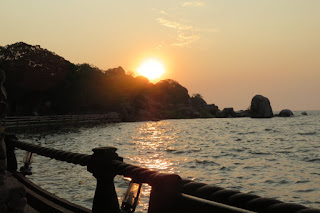
Once downtown, Nuru led me through the market and helped get some deals for me with her excellent bargaining skills. We then walked to the Chinese restaurant along the shore of Lake Victoria to enjoy an early dinner - and catch the sunset.
While we were eating we noticed that the park along the shore was littered with at least 8 different wedding parties. It was total chaos trying to maneuver down the street afterwards, with all their vans and buses lined up waiting for the photo shoots to end.
Below are a few pictures of the sunset, a typical tilapia fish and chips dinner, and a view of the big mall being built.
I told Nuru she could put me on a dalla-dalla to return to the lodge on my own, so she could head home from downtown. She, however, was very relieved to find Elizabeth (a teacher and fellow Rotarian) returning home on the same dalla-dalla as myself. Elizabeth ensured I got a seat (squished at the back of the bus again) and was able to get off at the correct stop. (Ironic wasn't it that I, a white person, was at the back of a bus of Africans? - Opposite to history in the US.) One man kept trying to get me to give him my money but I just told him that I wanted his money. I commented that the fact I was riding a dalla-dalla showed I didn't have money - or I'd be in a car. There was much joking around because I couldn't follow what was being said - but Elizabeth didn't look worried, so I was okay with it.
When we got off the bus, I lead the way to the Lodge - to prove to Elizabeth I knew my way. Elizabeth and I then made plans for me to go to her house for dinner on Wednesday - so her children could meet me. It is a big deal to have a mzungu visit. Elizabeth promised to show me how to wear the traditional skirt.
On Sunday I went with Delphine to her church. I didn't think it would be proper to take pictures of the service and I completely forgot to take pictures of Delphine's adorable children - Lillian (2) and David(5). I was surprised to see a monkey cross the road as we drove out to her house. She said the monkeys raided the bananas she tried to grow and would often come by her house.
As for the service itself, I don't think I could do it justice by writing about my experiences there. (Ask me later, if you're interested.) It was Pentecostal - African-style and so completely different from any Roman Catholic or Protestant ceremony I had ever attended. There was singing, dancing, and role-playing. We arrived late, but were there for over 2 hours. I was called up to the front at the end to speak to the congregation (with Delphine translating) and then the pastor requested I meet with him afterwards in his office. All I can say is, I am almost 100% certain he and his congregation will by praying for me - and for Canada. Homosexual relationships are illegal in Tanzania and he was quite upset to hear that not only are they legal in Canada, but couples can marry in churches and we even have large parades to celebrate being gay. I told the pastor it didn't bother me who a person loves, and it was not up to me to judge them. I don't think he was happy with that response. He was hoping I would tell him it was all a horrible rumour and there was no truth to our acceptance of the gay culture at all. Delphine was convinced her pastor had prophesized about my coming to their church, thereby solidifying her beliefs even more. I remain sceptical. Christianity in Tanzania is mixed with traditional beliefs - such as demon spirits, etc. They are very devout.
I was invited by Delphine to then enjoy a fish dinner - similar to the one above. I have to admit - I prefer tilapia as a filet, without the eyes and mouth.
Once downtown, Nuru led me through the market and helped get some deals for me with her excellent bargaining skills. We then walked to the Chinese restaurant along the shore of Lake Victoria to enjoy an early dinner - and catch the sunset.
While we were eating we noticed that the park along the shore was littered with at least 8 different wedding parties. It was total chaos trying to maneuver down the street afterwards, with all their vans and buses lined up waiting for the photo shoots to end.
Below are a few pictures of the sunset, a typical tilapia fish and chips dinner, and a view of the big mall being built.
When we got off the bus, I lead the way to the Lodge - to prove to Elizabeth I knew my way. Elizabeth and I then made plans for me to go to her house for dinner on Wednesday - so her children could meet me. It is a big deal to have a mzungu visit. Elizabeth promised to show me how to wear the traditional skirt.
On Sunday I went with Delphine to her church. I didn't think it would be proper to take pictures of the service and I completely forgot to take pictures of Delphine's adorable children - Lillian (2) and David(5). I was surprised to see a monkey cross the road as we drove out to her house. She said the monkeys raided the bananas she tried to grow and would often come by her house.
As for the service itself, I don't think I could do it justice by writing about my experiences there. (Ask me later, if you're interested.) It was Pentecostal - African-style and so completely different from any Roman Catholic or Protestant ceremony I had ever attended. There was singing, dancing, and role-playing. We arrived late, but were there for over 2 hours. I was called up to the front at the end to speak to the congregation (with Delphine translating) and then the pastor requested I meet with him afterwards in his office. All I can say is, I am almost 100% certain he and his congregation will by praying for me - and for Canada. Homosexual relationships are illegal in Tanzania and he was quite upset to hear that not only are they legal in Canada, but couples can marry in churches and we even have large parades to celebrate being gay. I told the pastor it didn't bother me who a person loves, and it was not up to me to judge them. I don't think he was happy with that response. He was hoping I would tell him it was all a horrible rumour and there was no truth to our acceptance of the gay culture at all. Delphine was convinced her pastor had prophesized about my coming to their church, thereby solidifying her beliefs even more. I remain sceptical. Christianity in Tanzania is mixed with traditional beliefs - such as demon spirits, etc. They are very devout.
I was invited by Delphine to then enjoy a fish dinner - similar to the one above. I have to admit - I prefer tilapia as a filet, without the eyes and mouth.
Subscribe to:
Posts (Atom)